The Animus Paradox
Gender, Agency, and the Expropriation of Female Intellect
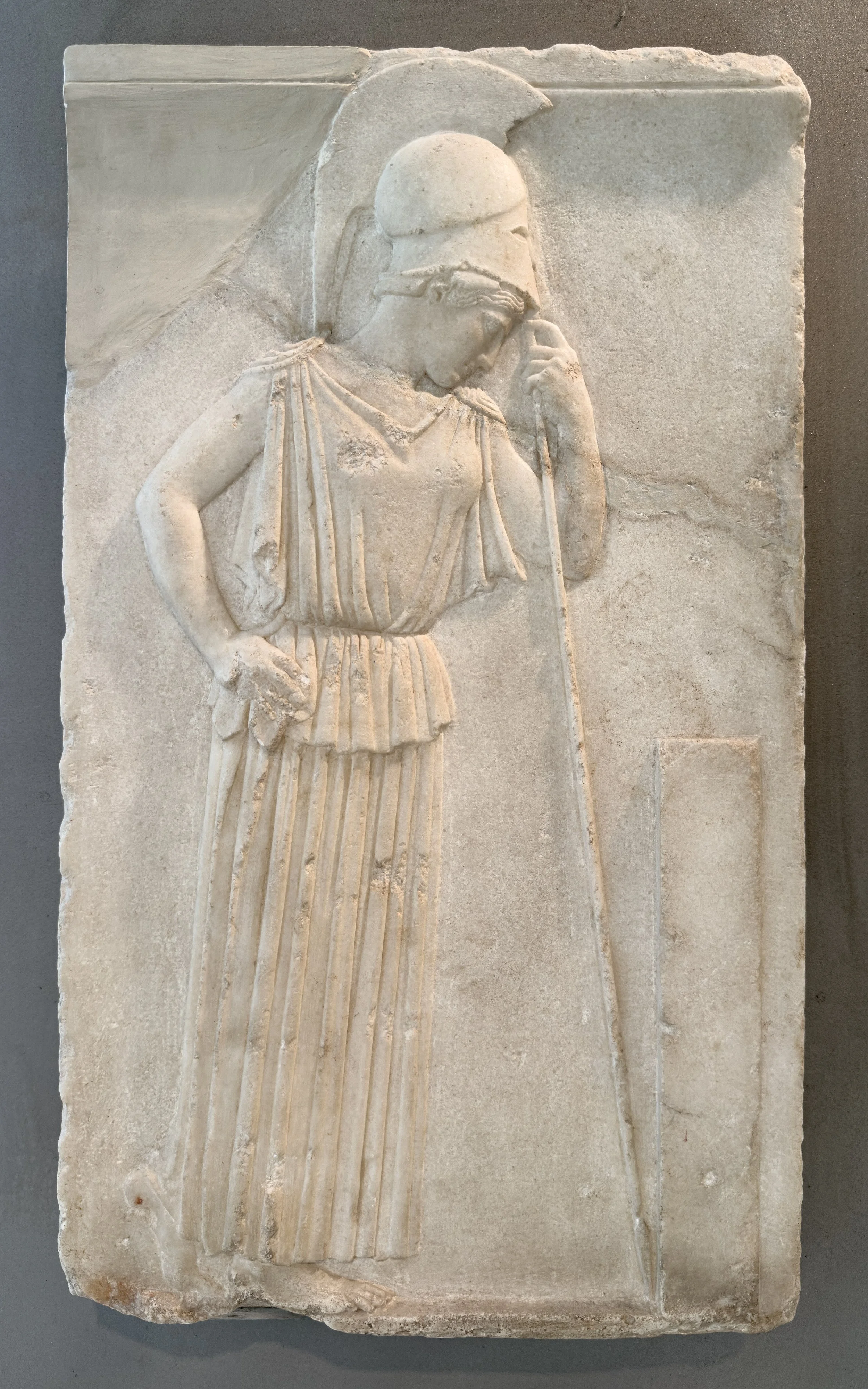
Pensive Athena (c. 460 BC). Classical representations of female wisdom and intellectual authority existed long before Logos was codified as intrinsically masculine. Photograph: Nikos Kitsakis, Wikimedia Commons

Jung’s theory of psychological wholeness begins by treating certain capacities as native to one sex and foreign to the other. Thinking, discrimination, and intellectual authority are characterised as masculine (Logos), while feeling and relatedness are characterised as feminine (Eros). Although Jung recognises that both principles exist in both sexes, he nevertheless organises psychic life around a fundamental gendered binary split.
In Aion (CW 9ii, §29), Jung writes that “[i]n women, on the other hand, Eros is an expression of their true nature, while their Logos is often only a regrettable accident.” He contrasts women’s supposedly natural orientation towards relationship with men’s orientation towards discrimination and cognition, establishing normative assumptions about the proper organisation of masculine and feminine consciousness.
The Animus as an Unconscious Masculine Principle
To understand why Logos is characterised as inherently masculine, one must examine Jung's conception of the animus. Jung asserts that “[w]oman is compensated by a masculine element and therefore her unconscious has, so to speak, a masculine imprint” (Aion, §29).
In Jungian methodology, the primary task involves differentiating the ego from these unconscious figures rather than simply identifying with them. However, a crucial asymmetry exists: the animus is an aspect of psychic organisation through which Jung locates capacities for discrimination, thought, and agency within an unconscious masculine archetypal structure in women, while associating those same capacities directly with men’s conscious psychological orientation. What is understood as an intrinsic aspect of masculine consciousness is, in women, attributed to an unconscious masculine principle that must be brought into conscious relation with the ego.
The Concept of Animus Possession
Animus possession is an established Jungian concept that carries explicit judgements about women who identify with supposedly masculine intellectual capacities. Jung writes in Two Essays on Analytical Psychology (CW 7, §337) that “[a] woman possessed by the animus is always in danger of losing her femininity,” comparing this to a man’s risk of becoming effeminate through anima possession.
This distinction is important. Jung is not merely describing a neutral process in which women develop their capacity for thought. He is proposing that identification with the masculine unconscious can actively threaten a woman’s femininity.
Granted, identification and integration are not synonymous for Jung; a woman is supposed to develop a conscious relationship with the animus without allowing it to dominate her ego. Yet while this distinction is real within the theory, its application remains deeply problematic.
This is particularly evident in the classical analytical literature that shaped early Jungian practice and training. Marie-Louise von Franz, in The Way of the Dream, describes animus possession in women as involving “abstract, opinionated thinking” alongside what she calls a cold masculine determination. Barbara Hannah, in The Animus: The Spirit of Inner Truth in Women, goes further by arguing that while a man’s conscious mind structures his writing, a woman’s literary structure comes from her animus—her spiritus rector. That formulation is remarkably revealing: even a woman’s intellectual and creative achievement is attributed to a masculine psychic agency.
The Illusion of Symmetry and the Persistence of the Binary
Of course, classical theory posits a structural symmetry: a man’s capacity for feeling, care, and relatedness is similarly attributed to an unconscious feminine principle—the anima—rather than his own conscious development. Yet this symmetry does not resolve the problem; it doubles down on its foundational flaw. By assigning essential human capacities to gendered archetypal figures, the framework alienates both sexes from the full spectrum of their own subjectivity.
Furthermore, while defenders might argue that Jung was merely reflecting the historical realities of early 20th-century Europe, these concepts remain active and operative in contemporary analytical discourse. Because Jung codified these cultural patterns as timeless archetypal structures rather than historical social conditioning, the theory continues to enforce those restrictions today.
It is also often argued that the ultimate goal of individuation is to move beyond gender—to transcend the binary through an androgynous ideal of psychological wholeness. But the pathway dictates the destination. If the method of reaching wholeness requires a woman to forever label her agency and intellect as "the masculine element within her," the binary is never actually dissolved—it is merely internalised and perpetually managed. The "androgynous" endpoint is built on an essentialist scaffolding that continues to gender human traits.
Implications for Women’s Intellectual Development
This theoretical framework has significant implications for how women’s intellectual development is understood. Because intellectual authority is conceptualised as inherently masculine in the first place, its exercise by a woman becomes inherently suspect, rather than being evaluated simply on how it is exercised.
This injunction—to develop a conscious relationship with the animus without becoming identified with or possessed by it—reveals a striking contradiction at the heart of Jungian integration. A woman must develop capacities deemed necessary for psychological wholeness while simultaneously guarding against excessive identification with the very principle through which those capacities have been defined. The theory creates a specifically female developmental difficulty and then presents the negotiation of that difficulty as a required step toward individuation. What appears to be a theory of integration ultimately preserves the original binary rather than questioning its legitimacy.
Ultimately, the core issue is not anatomical possession but the symbolic ownership of thought, agency, and authority. The woman may possess these capacities, yet their exercise is continually interpreted through her relationship to an unconscious masculine principle. What might otherwise be understood simply as the development of her own subjectivity is reduced to a matter of negotiating her relationship with the animus.